The most beautiful trips Karlovy Vary
The most beautiful trips in the Karlovy Vary region

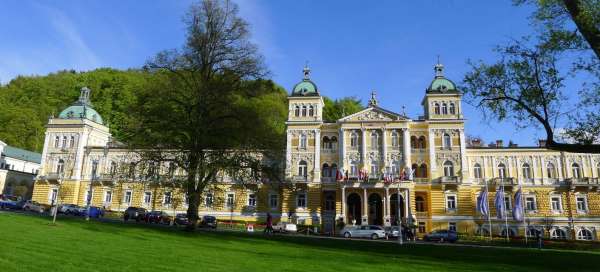
The most famous island of the Czech Republic is occupied by the world-famous Karlovy Vary. It is famous mainly for its spas – Karlovy Vary, Mariánské Lázně, Františkovy lázně and others. In addition, there is a beautiful landscape thanks to the Ore Mountains and Slavkov forests. You will also find other beautiful cities, castles and chateaux. Let's take a look at the beautiful trips you can take here
City tour of Loket
Picturesque city under the famous castle
The picturesque town of Loket has only three thousand inhabitants. It is located on a rocky promontory directly below the famous castle of the same name on the edge of the Slavkov Forest. The main artery of the city is TG Masaryka Street, where you will find all important local monuments. continue reading


A tour of Bečov nad Teplou
A historic town in the Slavkov Forest
Inside the Slavkov Forest you will find the beautiful historic town of Bečov nad Teplou, where you will find, among other things, a large castle with a palace and an adjacent Baroque chateau. For lovers of valuable monuments, there is also the famous reliquary of St. Maurus. After the coronation jewels, it is considered the second most important similar monument in the Czech Republic. continue reading

City tour of Cheb
On the island of western Bohemia
Just 40 km from Karlovy Vary and a stone's throw from the German border, you will find a city ideal for visiting in the afternoon. A pleasant walk through the town of Cheb has a lot to offer thanks to its rich history, but it is also a picturesque West Bohemian town with colorful houses on the square. The town lies on the river Ohře, along which you can walk on both banks. continue reading

SOOS
Czech Yellowstone
Yes, we also have active land. It is located in the west of Bohemia near Franstiškovy Lazní. The reserve was declared in 1964. Thanks to its peat bogs and mineral springs, which spring to the surface. They are called mud volcanoes. These are the echoes of volcanic activity. continue reading

A tour of Kynžvart Castle
Kynžvart journey II.
Former summer residence of the Austrian Chancellor Klemens von Metternich. continue reading

Gutštejn Castle
Romantic ruin
The romantic castle ruins are located near Konstantinovy Lázně. continue reading

A walk through Božídarské peat bog
After the largest peat bog in the Ore Mountains
Božídarské peat bog is the largest peat bog in the Ore Mountains. You can see it well if you set out from Boží Dar along an educational trail about three kilometers long. You will enjoy beautiful meadows and views not only of Božidarský Špičák. Thanks to the nature trail, you can learn about the local landscape and history continue reading


A tour of the Manětín chateau
Castle of the Lažanský family
Manětín Chateau is located in the town of Manětín in the northern part of the Plzeň-sever district and is connected with the Lažanský family. continue reading

Walk through Kladské peat bogs
Kladská nature trail
The roof of the Slavkov Forest could be called peat bogs around Kladská. At an altitude of over 800 meters above sea level, there is an extensive plateau full of lakes, rainforest and of course peat. Thanks to the rafts, a nice tourist circuit is open here, so you can also see this natural attraction. In addition, there are interesting historic buildings of the Swiss type. continue reading

Marianske Lazne
Maxim Gorky Colonnade
Mariánské Lázně – healing springs, amazing parks, cafes, restaurants, hotels, nature trails. And of course the colonnade. Today we look very closely at the colonnade of Maxim Gorky. continue reading

Kynžvart Spa
Significant but lesser-known spa
The town of Lázně Kynžvart lies in the middle between the more famous Mariánské and Františkovy spas near Karlovy Vary. Together with these well-known spas, local spas are declared by the Ministry of Health of the Czech Republic as a natural healing resource. Spa procedures are based on a beneficial climate, mineral waters and peat deposits. At present, non-tuberculous respiratory diseases and skin diseases are mainly treated here. continue reading

Sokolov - city tour
Former center of lignite mining
Sokolov is a town about 20 km southwest of Karlovy Vary, which was founded in the 13th century on the banks of the river Ohře at the confluence with Svatava. The oldest written mention of Sokolov (Falkenau in German) is from April 13, 1279, but the importance of the town increased only in the 19th century due to coal mining. At the time of the greatest expansion, 39 deep and 15 surface mines worked in the Sokolov district. The character of the city and the whole area was significantly influenced by extensive lignite mining and the chemical industry. After the decline in mining, extensive reclamation took place and lakes and parks were created in the vicinity. Today, the interesting places and monuments of this originally mining town stood out again. continue reading

Maria Loreto
Pilgrimage area
Baroque pilgrimage complex Maria Loreto with the chapel of the Virgin Mary of Loratan near Starý Hrozňatov near Cheb. continue reading

Upper Castle - Hauenstein
Hauenstein
Hauenstein was founded in the second half of the 13th century as part of the border fortifications. continue reading

A tour of the Teplá Monastery
Premonstratensian monastery
Teplá Monastery is located on the left bank of the river Teplá 1.5 km south of Teplá. continue reading

Rabštejn nad Střelou
Historic town near Manětín
Today I will give you a tip for an amazing trip near Manětín. We will visit the historic town of Rabštejn nad Střelou together, which was declared a town monument zone in 1992. continue reading

Chamber Hill
A unique Quaternary volcano
Approximately 2.5 km south of Františkovy Lázně there is a relatively inconspicuous forested hill formed by volcanic material. In its deforested eastern part is an abandoned pit quarry, adit and rock outcrops. It is one of the youngest volcanoes in the Czech Republic. This loose cone formed by basalt was created by a single explosion, during which hot lava and rocks were ejected from the subsoil. It happened sometimes at the beginning of the Quaternary, but the reverberations of volcanic activity are still evident today through the springs of carbon dioxide, mineral springs and occasional earthquakes. Today, Komorní hůrka is a national natural monument with an area of 7.1 hectares. There is an educational trail with information boards about one kilometer long. continue reading