The most beautiful places in Moscow
The best of the Russian capital

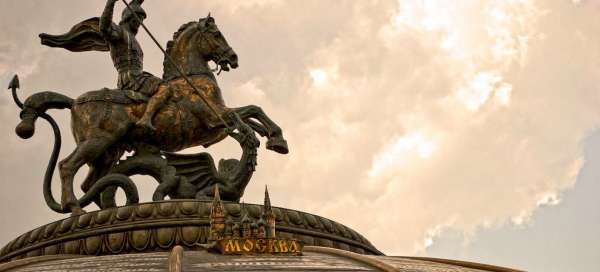
Moscow, the capital of Russia, the most populous city in Europe, the northernmost megalopolis in the world, with a historic center hundreds of years old, definitely has something to offer visitors. But it is important to set aside enough time to visit this city full of contrasts and monuments.
Moscow Kremlin
A tour of the political and spiritual heart of Russia
The vast Moscow Kremlin occupies an area in the shape of a triangle with an area of 27.5 hectares. It is located on a cliff above the Moscow River. Originally an independent city, over time its walls widened and shifted. For centuries, a flag with a double-headed eagle, a symbol of the Romanovs and Imperial Russia, flew here, and in 1917 it was replaced by red stars. Today, the Kremlin is the official residence of the president. The red Kremlin walls are 2.2 km long, 5 to 19 meters high, 3.5 to 6.5 meters thick, and have 20 towers. continue reading

Red Square and St. Basil's Cathedral
A tour of the most famous square and temple in Moscow
Red Square was established in the 1990s at the north-eastern Kremlin wall after the demolition of the buildings that originally stood here. The huge space (700 × 130 m) was used as a marketplace and also as a gathering place for rebels, and a place for political demonstrations and military searches. The square is hardly separable from the Kremlin and together with it is inscribed on the UNESCO World Heritage List. continue reading

Cathedral of Christ the Savior in Moscow
The largest orthodox church in the world
The Cathedral of Christ the Savior was built between 1839–1883 in honor of the victory of the Russians over Napoleon. Stalin let him down in 1931, but after the fall of the regime, the temple was rebuilt in the same place, and on December 31, 1999, he was ordained. It is the largest Russian church and the largest orthodox church in the world. It measures 103 m in height and holds up to 10,000 believers. continue reading

Novodevichy Convent and Cemetery
A tour of the most beautiful nunnery in Moscow
Novodevichy Convent is one of the most interesting places on the outskirts of the city and it is also one of the best-preserved and most beautiful Moscow women's monasteries. It was founded in 1524 by Grand Duke Vasily III. as a thank you for the liberation of Smolensk from the Lithuanians and is dedicated to the Smolensk icon of the Mother of God Odigitrije. For two centuries it served to intern the noble women. The complex has not undergone significant changes since the 17th century, so as an excellent example of the Moscow Baroque, it has been included on the UNESCO list since 2004. continue reading

Aleksandrovsky sad and Manezh Square
A walk through a green oasis close to the Kremlin
Aleksandrovský sad and Manéžní náměstí are located just behind the western part of the Kremlin walls. They stretch from the State Historical Museum in the north to the Moscow River in the south. Here the visitor to the city can relax a bit from the crowds of tourists walking along the Kremlin and Red Square. continue reading

Kitaj-gorod
A walk through the second oldest part of Moscow
Kitaj-gorod is an area of the city northeast of Red Square. In 1538, the whole area was surrounded by walls with 14 towers. It was the main business district of old Moscow. There were also 18 churches and 4 monasteries and in the era of the Soviet Union also government buildings. At present, the southern part of Kitay-gorod is being extensively rebuilt. continue reading

Theater Square
The famous “Bolshoi Theater“
In the center of Moscow lies the famous Theater Square, which houses both of Moscow's main theaters, the Great and the Small. In the middle of the square stands an amorphous monument to Karl Marx. The large theater was opened in 1776. Many times it was reduced to ashes and many times it was rebuilt. Its present appearance with the statue of Apollo and its sleigh dates from 1853. The small theater on the right side of the Great, was the leading stage in the 19th and early 20th centuries. Right behind it is the CUM building – a neo-Gothic department store from 1908. continue reading

Kolomenskoye Park
Former summer residence of the tsars
Already in the 14th century, Kolomenskoye became the first place where an out-of-town summer residence was built for the Grand Dukes and Tsars. In the Soviet era, it became a showcase of wooden architecture and stone monuments from all over Russia. Today, visitors can breathe the atmosphere of almost every period of Russian history. Countless cafes and restaurants will take you back to the present. continue reading

Church of St. Nicholas
The second most colorful temple in Moscow
Church of St. Mikuláš in Chamovniky dates from the end of the 17th century, its construction was ordered by local weavers. Its bright green and orange domes compete with St. Basil's Cathedral for the most colorful title in Moscow. It is a short walk from the city center, south of the Crimean Bridge, and although it is one of the most beautiful temples in Moscow, you will not find crowds of tourists here. continue reading

Stalin's "sisters"
Seven famous Moscow skyscrapers
Stalin's skyscrapers („sisters“, „highlands“) is the name given to the seven Moscow buildings that were built between 1947–57. These buildings are interesting not only from an architectural point of view, as the pinnacle of the post-war Soviet art deco style, but they also serve visitors to Moscow as excellent landmarks. The main building of Moscow State University, the Kotelnicheskaya House, the Hotel Ukraine, the Ministry of Foreign Affairs, the Kudrinskaya House, the Leningradskaya Hotel and the Krasny Vorota Building are definitely worth a visit. continue reading

State Tretyakov Gallery
The largest collection of Russian art
The famous Tretyakov Gallery, which houses the largest collection of Russian art, was founded by Pavel Tretyakov (1832 – 1898). He bought his first painting in 1856. For the next three decades, he collected more and more works. He opened his collection in 1881 and bequeathed it to the city in his last will. The facade of the museum in a special fairytale style was designed in 1904 by Viktor Vasněcov. The collection contains more than 130,000 exhibits, covering the period from antiquity to the avant-garde period. continue reading

Zachatievsky monastery
The oldest nunnery in Moscow
The Zachatievsky Monastery is the oldest nunnery in Moscow. In its place originally stood a wooden church from 1360. The area gradually expanded and the monastery flourished until 1547 when it was destroyed by a large fire. It was restored in 1584. The monastery stands in a quiet part of town south of the Cathedral of Christ the Savior, and although its main temple is one of the most beautiful in Moscow, many visitors to the city neglect it. continue reading

Bolotny island
Island on the Moscow river
The whole area south of the Kremlin was often plagued by floods, so a drainage canal was built here in 1783. Between it and the Moscow River, the river Bolotny Island (called Balchug) was created. In its western part is the main square and next to the famous House on the waterfront. A short distance away is Bolotné Square and also an interesting group of sculptures by Mikhail Šemjakin, called Children – Victims of Adult Vices. From the square over the Luzhkov Bridge, the boulevard leads directly to the State Trajakovsky Gallery. continue reading

House on the waterfront
Witness Stalin's purges
The famous Waterfront House on Bolotny Island is built in the late 1920s, as exclusive housing for senior Communist Party officials. During its existence, more than 100 ministers and 150 of their deputies took turns here. Khrushchev, for example, and Stalin's daughter Svetlana Allilujevová also lived here. During the Stalinist purges, 700 officials and their families were evicted from their homes, and many were imprisoned or executed. continue reading

Monument to Peter the Great
The most controversial Moscow statue
At the southern tip of Bolotny Island stands the most controversial of all Moscow sculptures by architect Zubar Cereteli. It is a megalomaniac memorial to the 300th anniversary of the Russian Navy, which consists of a giant statue of Peter the Great, standing behind the helm of a sailboat of the same size. The controversial statue has many supporters as well as opponents from the professional public and ordinary residents of Moscow. continue reading

Ostankino TV tower
The tallest free-standing building in Europe
Construction of the 540-meter-high Ostankin TV Tower began in 1963. Its author is the architect Nikolai Nikitin. In 5 years, after its opening, it has become the tallest building in the world. She maintained this title for almost a decade, until the opening of the CN Tower in Toronto. Today, it is the fourth tallest TV tower in the world and the tallest free-standing building in Europe. After a fire in 2000 that killed three people, the 55,000-tonne tower tilted slightly towards the city center. That's why the tower insured $ 114 million. continue reading

Moscow Museum of Cosmonautics
A tour of the museum under the Memorial to the Conquerors of the Cosmos
The Museum of Cosmonautics is located next to the VDNCh metro station. It is located in the lower part of the Monument to the Conquerors of the Cosmos, a titanium structure 100 m high, at the top of which stands a rocket heading into space. The largest part of the museum's expositions is dedicated to Yuri Gagarin's first flight into space in 1961. Here you will also find the famous dog crew Bělka and Strelka, stuffed with the first live visitors to the orbit. continue reading

VDNCH Exhibition Center
Pompous monument of lost Soviet glory
The Moscow Exhibition Center VDNCH (Exhibition of Achievements of the National Economy) commemorates the past Soviet glory. In the 1930s, the idea arose to present the successes of individual republics, regions and areas of the USSR, and for this purpose, several pavilions were built here in the style of socialist realism. Each pavilion represented a certain area and was also decorated with motifs typical of that region. During the Second World War, the exhibits were transported to Chelyabinsk and the area did not resume its activities until the 1950s. continue reading

Victory Park
A walk through a large war memorial
On the outskirts of Moscow, behind Kutuzovsky Prospect and the Arc de Triomphe, on the Mount of Thanksgiving, there is a huge green space, a large war memorial over 140 hectares, Victory Park (Victory Park). To mark the 50th anniversary of the victory over Nazism, the complex was opened by former Russian President Yeltsin. continue reading

Lomonos State University
One of “Stalin's sisters“
Stalin's sisters (высотки) is a designation for seven high-rise buildings that were built in Moscow in 1947–1957. The most impressive of these is the building of Lomonosov Moscow State University. The building is 240 m high. It includes a large area with a large park area, botanical garden and more than fifty buildings with a capacity of 6,000 student rooms. Not far from the complex is the Sparrow Hills park with an impressive view of the city and the Moscow River. continue reading

Moscow metro
An architectural gem in the underground
The Moscow metro forms a network of twelve, mostly underground lines with a total length of 334 km and is one of the largest systems of its kind in the world. It was opened in 1935. After the Tokyo subway, it is the second busiest subway in the world. During a normal working day, it carries 10 to 11 million passengers, over 2.5 billion a year. By 2020, it should be extended by another 137 km and 64 stations. It is often described as the most beautiful metro in the world due to its interesting architecture and station decoration. continue reading

Moscow-City
City in the city
The „City within a City“, as Moscow's City Business District is called, is located on the Presnen District, in the western part of the metropolis on the banks of the Moscow River. It is the first place in Russia and Eastern Europe that serves the purpose of business, residential and entertainment districts. Construction began in 1992. The entire complex is built on the Krasnopresnensky embankment and has an area of about 100 hectares. Until recently, we will also find the tallest building in Europe, the 374-meter-high Federation Tower. (In 2017, it was surpassed by the St. Petersburg skyscraper Lakhta Center). continue reading

Moscow White House
The seat of the government of the Russian Federation
The White House building stands on the banks of the Moskva River, towards the City district on the Krasnopresnen embankment. It was built in 1965–1979 according to the plans of architects Čečulin and Šteller. The building has always served government purposes, after the collapse of the Soviet Union, the Russian parliament was located here. The Government of the Russian Federation has been based in the White House since 1994. In 1993, the White House became the center of anti-Shelcin resistance from the Russian parliament. Yeltsin broke his opponents only after he ordered the army to attack the building. continue reading

Tverskaya Street
The former old Tsarist Way
Tverskaya Street once connected Moscow with the nearby Principality of Tver. It was also called the Tsarist Way, because the Tsars and Empresses used it on their way to the capital. In 1930, it was expanded from the original 18 to 60 meters. Today, Tverská Street is the busiest shopping street. At its beginning, in the direction from Red Square, stands the impressive gray building of the State Duma. In the middle of the street stands the Equestrian Statue of Yuri Dolgoruky, the city's founder, and opposite it rises the red building of the Main Moscow City Hall. continue reading

Old Arbat
The most famous pedestrian zone in Moscow
The Old Arbat pedestrian zone is by far the most famous street in Moscow, sought after by tourists and full of street performers, cafes, restaurants and pubs. The name Arbat, which first appeared in 1475, comes from the Arabic word „rabat“. The Arabs lived here as early as the 15th century and in their language the rebate referred to the suburbs. The whole local district is called Arbat, but today's Old Arbat has always been the main artery of this district. Here you will find the Pushkin Museum, Vachtang Theater, Bulat Okudzhava Memorial … continue reading

Lenin prospect
Prospectus with a statue of Gagarin
Lenin Prospect is one of the main arteries in Moscow. It is part of the European route E101 connecting Moscow and Kiev. At the same time, it is the second largest street in Moscow, with a width of 108 to 120 meters. The prospectus intersects Gagarin Square with a statue of Gagarin on a 42.5 meter high pedestal. On the other side is the building of the Russian Academy of Sciences. continue reading