
Gdańsk – Medieval Crane (Stary żuraw portow
City icon - a unique medieval pulley crane

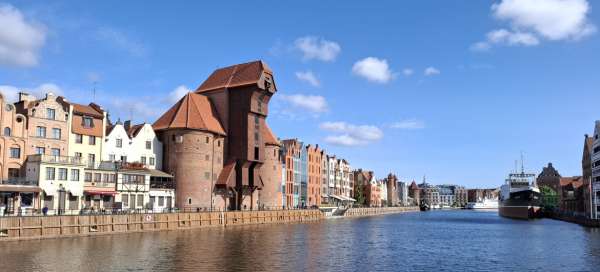


One of the most iconic symbols of the city of Gdańsk is undoubtedly the Żuraw, or medieval crane. This imposing wooden structure, which dominates the Motława River, is not only a fascinating testament to medieval engineering, but also a living testament to Gdańsk's prosperity and importance as a port city.
This crane is one of the few reconstructed historical treasures of medieval port technology in Europe. Its unique construction is a testament to the technical skill of the builders of that time.
Old Port Crane
Stary Żuraw, sometimes also called Brama Żuraw, is an iconic Gdańsk landmark and one of the main symbols of the city. The Czech translation „Old Crane“ or „Gate with a Crane“ will sufficiently explain what kind of monument it is.
Gdańsk has always benefited from its location on the Baltic Sea and has been the main port for the entire region. On the embankment of the Moltawa River, near its mouth into the bay, you can admire a historic crane used for loading and unloading sea and river ships.

The oldest surviving harbor crane in Europe
The Žuraw (Czech for „Crane“) is the oldest preserved port crane in Europe and one of the most important symbols of Gdańsk. Its history dates back to the 14th century, when it was built between 1367 and 1444. The over 11-meter-high historic crane refers to the era of Gdańsk as a highly successful trading city. The first preserved collection of a cargo crane dates from 1367, however, it was demonstrably created in its current form only in 1442–1444. A massive stone gate was subsequently built on both sides of the crane in the typical Flemish Gothic style. The crane thus served both as an industrial facility and as a defensive fortress

History
The first mention of a wooden crane dates back to 1367. This brick structure, which combined the functions of a port crane, city gate and defensive wall, was built in 1444. It was a structure consisting of two massive towers (the walls on the ground floor are up to 4 m thick), between which a wooden crane structure was built, overhanging the embankment and supported by two consoles ensuring the passage of the gate.

The fate of the crane and the city
The Crane experienced its greatest prosperity in the 16th and 17th centuries, when Gdańsk was one of the most important European ports. In the 18th century, fewer and fewer goods were transported there, and from the 19th century, its lower floors were occupied by small shops and workshops, while the upper floors were used by the poor. During World War II, the Crane shared the fate of almost all the buildings in the Capital, being 80% destroyed and burned down. After the war, it underwent careful reconstruction and in 1962 became the first seat of the Maritime Museum – today the National Maritime Museum.

Crane construction
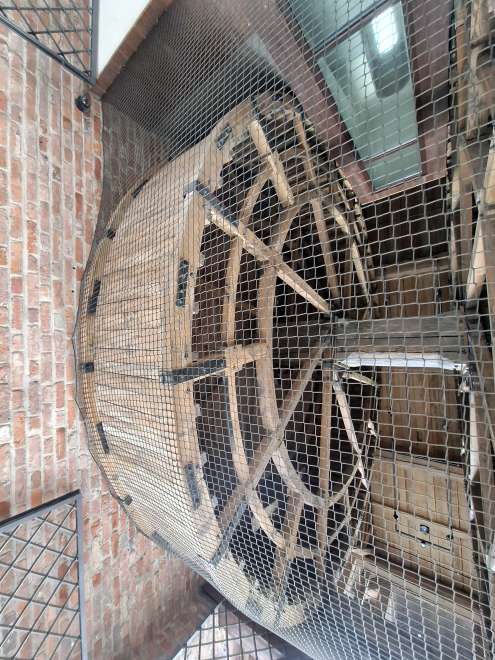
Its construction is astonishing – it is a massive wooden structure with two pairs of huge wheels powered by human power. These machines, often powered by dozens of workers, allowed to lift loads weighing up to 2,000 kilograms. This was an incredible technical solution in the Middle Ages, which greatly facilitated trade and contributed to the prosperity of Gdańsk.

Harbor guardian and symbol of power
Thanks to Žuraw, the city became one of the most important trading centers in the Baltic Sea region, where goods were imported and exported from all over Europe.
In addition to its role in trade, the Žuraw also had a defensive function. Its massive walls and towers served as part of the city's fortifications, protecting the port from enemy attacks. At night, the gate was closed and a rope with a pulley was raised, preventing unauthorized ships from entering.
The Žuraw underwent several reconstructions and repairs, especially after fires in the 17th century and devastation during World War II. After the war, it was carefully reconstructed into its present form, which faithfully reflects its original appearance.

Visiting Žuraw and its surroundings
Today, Żuraw is one of the most photographed and visited places in Gdańsk. It is located in the heart of the old town, right on the Motława River embankment.
A visit to Żuraw is an unforgettable experience that will allow you to gain insight into the rich history of Gdańsk and understand the important role this city played in the history of European trade. It is a place where the past meets the present and where you can feel the pulse of ancient times.

Crane mechanism
The crane was used for handling heavy goods and assembling masts on ships. Its drive mechanism initially consisted of one, and later of two pairs of running wheels with transversely mounted spokes, on which workers walked and set the wheels in motion. This made it possible to wind or unwind a rope with a hook onto a shaft connecting the wheels and transport it to the lift opening. With the upper set of drums, it was possible to lift 2 tons to a height of about 30 m. After connecting the sets of drums, they could lift 4 tons to a height of 11 m.
Articles nearby




Giga List: Gdansk - what to see
Architecturally rich, Gdańsk on the Baltic coast is rightly considered one of the most beautiful cities in northern Europe. Once… continue reading


