The most beautiful places of Mongolia
The best of Mongolia

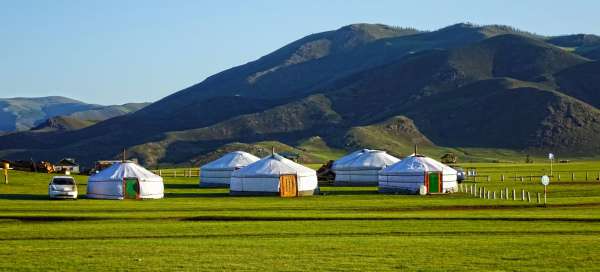
Mongolia is the second largest landlocked country in the world after Kazakhstan. At the same time, it is a country with borders furthest from the sea coast, as much as 700 km. It measures 2,392 km in the west-east direction and 1,259 km from north to south. It borders only two states, Russia and China. With its area it is 22 times larger than the Czech Republic and with only 3.4 million inhabitants it is one of the most sparsely populated areas in the world. It is divided into 21 ajmags and 329 somons. The capital Ulaanbaatar is administered separately.
Ulagchiin Char Nuur lake
A marvelous lake in the middle of the desert
In Dzavchan Ajmag, near the town of Zavchanmandal, at an altitude of 1980 meters, is located Lake Ulagchiin Char Nuur (Black Lake). It is rich in fish and many waterfowl live in the area. The lake stands out with its turquoise blue color, which is best seen from the height of the surrounding hills. Surrounded by sand dunes, which in many places fall directly into the water and are renowned for changing color depending on the time of day. From the height you can see the island of Ich. continue reading


Erdene Zuu Monastery
One of the most important monuments of Mongolia
The Buddhist Erdene Zuu Monastery (probably the oldest in Mongolia) was founded at the end of the 16th century by the Khan Abatai at the site of the former Chinghish settlement town of Karakorum (Kharkhorin). Inside the square (400 × 400 m) square, surrounded by a massive wall, today there are several functioning temples. continue reading

Chuvsgul Nuur Lake
The second largest Mongolian lake
The volcanic lake is part of the Baikal Rift Ditch Zone, which originated 55 million years ago. Chuvsgul is one of the oldest lakes in the world, the 14th largest freshwater lake in the world and is the deepest Mongolian lake (depth of 262 m, water volume 381 km3). Lake water accounts for up to 2% of the world's freshwater. Its length is 134 km and the largest width is 39 km. continue reading

NP Gorchi-Tereldz
National park near the capital
The national park with an area of 293,168 ha was declared in 1993. Rare minerals have been mined in its territory for over 100 years. Some parts of the park are permanently inhabited by pastoralists who maintain their herds in the peripheral zones. Thanks to the beautiful landscape and proximity to the capital, the NP is one of the most visited places in Mongolia. In summer, there are many opportunities for hiking, climbing, swimming, rafting, horseback riding or bird watching. In winter it is possible to try skating on frozen rivers. continue reading

Uliastaj
The heart of the Dzavchan ajmag
Uliastaj, the administrative center of the Dzavchan Ajmag, is a quiet and pleasant town with hotels, restaurants and a market in the city center. The gazebo on the hill above the town, next to the monastery, offers nice views of the surrounding countryside. Above you will find a statue of an elk, an argali sheep and an ibex. The neighboring monastery was opened in 1990 and local friendly monks allow tourists to attend services. From the viewpoint you can see the shapes on the opposite mountain. continue reading

Tsetserleg
The “Garden“ of the Archangay Ajmag
The city of Tsetserleg, or also Cecerleg (translated as „Garden“), is the administrative center of the Archangay (North Thai) Ajmag. It is 463 km from Ulaanbaatar. It lies at an altitude of 1651 m above sea level, at the southern foot of Mount Bulgan and includes the Dzajajn Chüree monastery complex. The city is interwoven with spacious streets and is one of the most beautiful in the country. From the main museum in the center, the road leads to the Bujandelgeruulech Shrine in the hills from where there is a beautiful view of the entire valley and the Changaj Mountains in the south. continue reading

Ulaanbaatar
Capital of Mongolia
Ulaanbaatar means Red Hero. And it is not just the name that shows the considerable influence of the northern neighbor. Wild socialist architecture, growing regardless of its surroundings, is only the most striking example. Half of the Mongolian population lives here and more. One cannot even believe that he is in the land of nomadic herdsmen. With an average altitude of 1300 m, the weather in Mongolia's capital is like a swing. It is also the coldest capital of the world. continue reading

Charchorin
A modern city based on the legendary Karakorum
The modern agricultural city of Charchorin is located 373 km southwest of Ulaanbaatar in the Orchon River Valley. The city is located on the edge of the Changaj Mountains. Not far from it lies the foundations of the ancient, once magnificent city of Karakorum, founded in 1235. Two kilometers from the center of Charchorin is the oldest Mongolian monastery Erdene Zuu, which is a destination for most tourists. continue reading

Choridol Saridagiin Nuruu
Mountains and strictly protected area at Lake Chuvsgul
The Choridol Saridag Protected Area with an area of 1886 km2 was established in 1997. It is located in the Chuvsgul Ajmag, on the western shore of Lake Chuvsgul Nuur. It borders the Darchad valley on the east side. The mountain range is 150 km long and its highest peak is Delgerchaan Uul (3093 m). The other two notable peaks are Ich Uul (2961 m) and Uran Dosh Uul (2702 m). The mountain range is rich in phosphorite and the remains of its massive mining in the 1980s are still visible here. continue reading

Ulaan Tsutgalan Churchree
Red waterfall on the river Orchon
The waterfall was formed as a result of volcanic eruptions about 20,000 years ago and its water falls from a height of 20 meters. It is located 80 km west of the village Chuzhirt, in the Changaj Nuruu National Park, in the area of the Orchon River Valley, which is listed as a UNESCO World Heritage Site. It is a beautiful, quiet place with untouched surrounding nature and almost zero settlement. Down the current there is a deep abyss and a few km further there is another smaller waterfall. continue reading

Orchoni Uurtiin Tochoi
Cliffs in the canyon of the river Orchon
Orchoni Uurtiin Tochoi are cliffs forming a canyon in the meander of the Orchon River. It is located in the Changaj Nuruu National Park and is also one of the most beautiful places in the Orkhon Valley, a UNESCO World Heritage Site in 2004. continue reading

Changaj
The second highest mountain range of Mongolia
Changai (with the highest point Otgon Tenger Uul, 4031 m) is a mountain range in western Mongolia located about 400 kilometers west of Ulaanbaatar. Together with the ridge of the Eastern Sayan Mountains and the Mongolian Altai, it is one of the three highest mountains in the country. The massif rises from the Mongolian Highlands and descends to the northeast through the valley of the river Ider to the vast valley of the river Selenga. To the east and southeast it connects to the Gobi Desert. One of the most beautiful Mongolian rivers, the Orchon, springs in the Changai massif. continue reading

Chujsiin Najman Nuur
The area of eight lakes
Chujsiin Najman Nuur (Eight Lakes Region) is a remote mountainous area in the southern part of Changaj Nuruu National Park with an area of 11,500 hectares. Transport to these places is quite complicated and therefore the area is only minimally visited by tourists. The local lakes, located in the long and wide valley that separates the Gobi-Altai from the Changai Mountains, formed many centuries ago during extensive volcanic eruptions. The largest and most beautiful of these is Lake Shireet Nuur. Others are Chaljun, Bugat, Chajá, Chujs, Šaná, Duroo and Baga. continue reading

Mongolian sands
Sand dunes in the heart of Mongolia
About half a day's drive in the northeast of the city of Bulgan in western Mongolia, the wind blows a hundred kilometers of dunes. Mongolian sands (Mongol Els) is one of several areas of the same name in the country where one can enjoy the sandy splendor. She is such a little sister of the Gobi Desert, but she will definitely not get along with her beauty. continue reading

Telmen Nuur Lake
Salt lake
Telmen Nuur is a salt lake southwest of the Bulnai Mountains. It is located at an altitude of 1789 m, roughly 20 km northwest of Telmen. It is the largest lake in Dzavchan Ajmag, 30 km long, 16 km wide and its area is 198 km2. Its largest depth is only 5.5 m. The best place to camp is at the eastern end of the lake right by the water. The air at the lake resembles the sea. There are three islands and many migrating birds on it. continue reading

Terchiin Cagaan Nuur Lake
The White Lake on the Terleh River
In the middle of the Chorgo-Terchiin Cagaan National Park at 2054 m above sea level is located the beautiful Lake Terchiin Cagaan Nuur. The lake (16×20 km), with a depth of 10 meters, is surrounded by extinct volcanoes. Some parts of the coastline are sandy and in summer the lake water is warm enough to swim. There are pike and perch in the lake. From the northeast edge of the lake you can climb to the extinct volcano Chorgo Uul (2965 m above sea level). continue reading

Chustain Nuruu NP
Home of wild horses
The national park located in Central Ajmag is an example of the steppe landscape of the southwestern part of the Chentí mountain range. Its area is 50,620 hectares. In front of the entrance to the park lies the sand dunes Moltsog Sands. The park is home to wild Přewalski's horses – tachi, which were recently returned to Mongolia from European breeding zoos thanks to the Dutch Foundation. In addition to horses, there are also red deer, steppe gazelles, wild pigs, wild cats, wolves and lynx. continue reading

Genghis Khan's Monument
Tribute to the greatest Asian conqueror
The 40-meter-high and 250-ton steel equestrian statue of Genghis Khan lies on the banks of the Tuul Gol River, about 54 km east of Ulaanbaatar, the place where, according to legend, Genghis Khan's golden whip was found. The statue, which symbolically faces east to his birthplace, was designed by sculptor D. Erdenebileg and architect J. Enkhjargalem. It was completed in 2008. continue reading

Green Palace in Ulaanbaatar
The Winter Palace of the last Mongolian Bogd-khan
Bogd-khan's Green (or Winter) Palace was built in 1905 and served as the seat of the eighth and last Bogd-gegen (Bogd-khan) of Jebcundamp Chutucht, a Mongolian religious and political leader who died in 1924. The palace with a large temple complex is surrounded by a wooden fence. It is located in the southern part of Ulaanbaatar, near the Tuul Gol River and Bogd Uul Mountain. In 1961, a museum was established here, which includes a number of very valuable exhibits and works of art. continue reading

Tuvchun Chiid
Buddhist monastery in the mountains of Changai
Tuvchun Chiid is a specific smaller mountain monastery, located at an altitude of almost 2250 m above sea level below the top of the Red Mountain. It was founded in 1648. During anti-religious repression, it was completely destroyed in 1939. It was restored in 1997 and the monks returned to it. continue reading

Chojin Lama Sum
Buddhist monastery under the skyscrapers of Ulaanbaatar
Chojjina Lama Temple was built in the first decade of the 20th century to serve the younger brother of the last religious leader of Mongolia, who was also a state oracle. This museum temple is located in the center of Ulaanbaatar, directly below Suchbátar Square, south of Mírová třída, in a modern building. In the temple complex we find the Main Temple (a temple that spreads compassion), the Macharaji Temple, the Dzuu Temple dedicated to Buddha Shaakyamuni, the Jadam Temple and the Amgalan Temple with a statue of the goddess Tara. continue reading