Prague – main train station
A historical gem in the heart of Prague

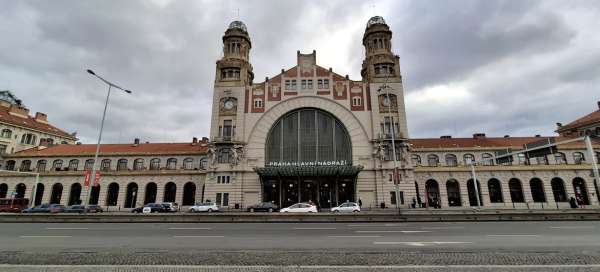





Prague's Main Railway Station is not only a transport hub, but also an architectural gem with a rich history. It represents a truly majestic gateway to our metropolis. Its current appearance is the result of many reconstructions and architectural styles that blend here.
In 1869, construction of the first station building in the Neo-Renaissance style began on this site. The station, then called Emperor Franz Joseph I Station, was officially opened on December 14, 1871.
The historic building of Prague's main station is therefore a protected cultural monument.
Reconstruction by Josef Fanta
However, with the growing importance of railway transport, the original building soon became insufficient in terms of capacity. At the beginning of the 20th century, it was decided to rebuild and expand it. The architectural competition was won by Josef Fanta, who designed a new, Art Nouveau building. Construction took place between 1901 and 1909, and the result was an impressive work that we still admire today.

Fant's building
The dominant element of the entire complex is the Fant Building, which is considered one of the most beautiful Art Nouveau buildings in Prague.

Art Nouveau pearl
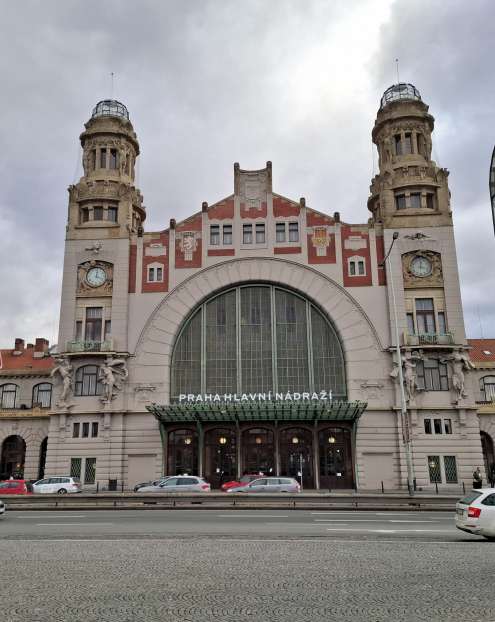
Fanta's architecture is characterized by rich decorations, stained glass, stucco and sculptural elements. The central hall is illuminated by a glass vault, which gives the interior airiness and elegance.
From the outside, the building impresses with its monumentality and rich decoration. The facade is decorated with stucco, allegorical statues and reliefs that refer to the railway and transport. The dominant element is the facade with a large glass window that illuminates the main hall. Above the entrance is a sculpture with a winged wheel, a symbol of the railway.
Reconstruction of the Fanta building
At the beginning of 2024, an extensive reconstruction of the Fanta building was completed, restoring it to its original splendor. The facades, stained glass windows, stucco decoration and other interior elements were restored. Today, we can admire this Art Nouveau pearl in its full glory.
However, some areas are only accessible during booked guided tours.

Main hall
The main hall impresses visitors with its glass vault, high ceilings and marble floor, giving the impression of a theater space. The light penetrating through the stained glass creates a play of colors and shadows that gives the interior a magical atmosphere.

The vault of the main hall
The glass vault above the main hall is a masterpiece of glass art. Its structure is made of steel beams and glass panels with ornamental motifs. The stained glass windows depict allegorical figures and symbols that celebrate technical progress and transportation.

Foyer café
This charming Art Nouveau space originally served as a waiting room for first and second class passengers. It is decorated with rich stucco ceiling decoration and related sculptural elements. The walls and ceiling of the hall are decorated with rich stucco ornaments with plant and geometric motifs, typical of the Art Nouveau style.
An interesting fact is that this is the only part of the historic north wing with a flat ceiling, as everywhere else the ceiling has a barrel vault.

Fant's Hall
The impressive hall, with a total area of 356 m2, originally served as a first and second class restaurant. The monumental space with a barrel vault and lunettes is decorated with colorful stained glass windows with the motif of a winged wheel, the symbol of the railway.

Gilded national emblem
During the reconstruction, a painted gilded coat of arms of the First Republic with the inscription „Truth triumphs“ was found on the wall. This coat of arms was supposed to be used to welcome TG Masaryk, the first president of the Czechoslovak Republic, upon his return from exile after the declaration of an independent Czechoslovakia in October 1918.
A replica of a monumental period clock is placed below the emblem.

Multifunctional space
Today, the beautifully renovated hall serves as a multifunctional space for various events. The hall is illuminated by original brass Art Nouveau chandeliers, complemented by modern adjustable spotlights around the perimeter of the walls. It is possible to rent it commercially.

Connecting corridor
From Fant's Hall, a corridor with a barrel vault and rich paintings leads north. On the walls are allegorical masks representing individual continents. Also worth noting are replicas of period lamps, beautifully restored stucco decoration and paintings with floral motifs.

Columned Hall
At the end of the corridor is the Column Hall, which is a true jewel of Czech Art Nouveau architecture. It was intended as a waiting room and a Class III restaurant. Visitors will be impressed by the rich stucco decoration and preserved colorful stained glass windows with Art Nouveau motifs.
The name of the hall is determined by the fact that the entire monumental space is divided by four massive pillars.

Main pillars
Female figures on the four main pillars represent the four seasons. The side pillars are decorated with allegorical figures of hunting, fishing, field and farm work.

Ceramic mosaics
The original ceramic mosaics from Rakovník Šamotka have been preserved on the columns. They have remained intact, despite the fact that a station restaurant was operated here in the mid-20th century.

Farewell Monument
Directly under the dome of the Fanta building, in the corridor leading to the platforms, there is the „Farewell Monument“. It is an exact replica of a wooden door with external sheet metal from a third-class passenger train carriage. Together with a commemorative plaque, it commemorates the rescue of 669 Jewish children. They traveled from Prague in 1939 thanks to the heroic act of Sir Nicholas Winton and thus escaped death in German concentration camps. The ceremonial unveiling took place on May 27, 2017.

Woodrow Wilson Memorial Plaque
In the corridor to the platforms, opposite the farewell monument, there is a memorial plaque made of white marble with a portrait of the American President Woodrow Wilson, who contributed to the establishment of Czechoslovakia. The plaque was unveiled on November 16, 1990 in the presence of the US President George Bush. This also returned the honorary title of „President W. Wilson Station“ to the station.

Statue of Nicolas Winton
At the first platform there is a moving bronze monument, statue and plaque dedicated to Nicolas Winton, who saved hundreds of Jewish children from the German occupiers. In 1939, Winton saved 669 children from being transported to concentration camps by organising their departure to England. The children never saw their parents again, as they were murdered in German concentration camps. The monument is also dedicated to the 15,131 children murdered in concentration camps.
On the adjacent building there are memorial plaques to railway workers who were murdered during the German occupation.

New check-in hall
In the 1970s, a new departure hall was built in front of and below the historic building, which was connected to the metro station in 1974. Today, most passengers in a hurry don't even notice the Art Nouveau gem above them. They may be reminded of it by a LEGO model of the building when watching the train departure panels.