The most beautiful places in the Highlands
The best of Vysočina

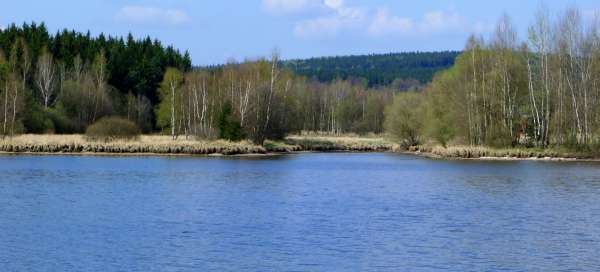
The Vysočina region is located in the vast Bohemian-Moravian Highlands on the border of Bohemia and Moravia. Its axis is not only the infamous D1 motorway, but also the river Sázava. It offers picturesque nature, several interesting cities and beautiful sights. Come take a look at the most interesting ones
Pernštejn Castle
The most beautiful Moravian castle
Pernštejn Castle, being an architectural jewel in the forests of the Bohemian-Moravian Highlands. Is often referred to as the „King of the Moravian Castles“. It overlooks the village of Nedvědice and looks very monumental and mysterious. This exceptionally preserved medieval castle was the base of the lords of Pernštejn. However, the late Gothic and early Renaissance style of the castle was not affected by any further rebuilding. continue reading


Telč
Town jewel
The town of Telč, due to its importance in the UNESCO list, has a unique location. The Historic Outing City is almost all around by the ponds. The town is dominated by the Telč Chateau and then by the beautiful square Zacharias of Hradec, crowned with magnificent burgher houses. continue reading

Zelená Hora
A jewel from Jan Blazej Santini-Aichel
On the northern outskirts of Žďár nad Sázavou you will find a complete Baroque gem on Zelená Hora by the famous architect Jan Blažej Santini-Aichel – the Church of St. John of Nepomuk. Thanks to its significance, it has been included in the UNESCO World Heritage List. Around the church is built ring of cloisters continue reading

Třebíč
A city with Jewish history
Třebíč's monuments are like a live open-air museum. In the Jewish quarter, music is often heard, and the local creators read in Kabbalah overnight. There are plenty of wineries, cafes and pubs, and travelers from all over the world are happily sitting on the bank of the Jihlava River. From the St. Basil's Cathedral. Prokop, which is only a few meters away from the miniature Jewish town, is organically sounded by the organ, and in the courtyard of the former monastery and chateau slowly trot groups of tourists. Třebíč perhaps best describes the race in slow smoking, which takes place every year in the local museum. Time is passing slowly, and history buried in the stones of the Jewish city, tombstones of the great Jewish cemetery and basilica intermingle with the present. In 2003, these three monuments were listed on UNESCO. continue reading

Havlíčkův Brod
The town of Karel Havlíček Borovský
At the river Sázava you will find the picturesque town of Havlíčkův Brod. The most visited part of the city is the Havlíčkovo náměstí with nice burgher houses. A little further is the mighty church of the Assumption of the Virgin Mary. There are also remnants of city walls with bastions. continue reading


Pelhřimov
Base to the highlands
Pelhřimov is a well-known tourist destination on the Bohemian-Moravian Highlands. It is also worth visiting thanks to its picturesque Masarykovo square, the castle and the observation tower. There are also remains of city walls and gates. continue reading

Open-air museum Veselý Kopec
Open-air museum of Vysočina region
Open-air museum Veselý Kopec is a settlement full of dispersed interesting farmhouses from the 19th and 20th centuries taken here from different parts of Vysočina region. In addition, you can see here also technical monuments on water drive (mill, oil, iron mill). A short but very nice circuit will introduce you to the life of farmers and craftsmen over a hundred years ago. continue reading

Lipnice nad Sázavou Castle
Jaroslav Hašek Castle
Lipnice nad Sázavou became famous for its native Jaroslav Hašek, the author of novels about the good soldier Švejk. The town has, but also another attraction – a beautiful medieval castle towering on top of a hill. From the castle there is a beautiful view of the surrounding Bohemian-Moravian Highlands. Its dominant feature is the beautiful Samson Tower. The chapel of St. Lawrence is also interesting continue reading

Water reservoir Seč
Beautiful dam in Železné Hory
The Seč Reservoir can be found at the northwestern end of the Iron Mountains, just a short south of Chrudim on the Chrudimka River. It is a popular holiday destination. In addition, you will find two ruins – Oheb Castle and Vildštejn Castle continue reading

Church of St. Of St. James in Velká Losenice
Church with a famous ossuary
Velká Losenice boasts an interesting church of St. Jacob with a bell tower and an impressive ossuary, which is the main attraction of the visit continue reading

Open-air museum Bethlehem
Folk buildings in the middle of Hlinsko
Right in the middle of Hlinsko you will find an interesting open-air museum of folk buildings from the Vysočina region. The open-air museum is in one part adjacent to the river Chrudimce. It includes a museum in the nature of Vysočina. continue reading

PR Velká and Malá Olšina, PR Hroznětínská louka
Wandering the snowflakes
The Velká and Malá Olšina Nature Reserves and the Hroznětínská louka Nature Reserve are located on the edge of the Vysočina region. It consists of a large forest, which seems uninteresting, but always with the arrival of spring, its wetlands become a flowering garden. It's a paradise for snowflakes. The advantage of this area is that it is unknown and is only visited by locals. For a day trip, I can recommend Číhošť as the center of the Czech Republic and the Číhošť Miracle, the National Technical Monument in Tasice and one of the largest wooden lookout towers in Europe, Bohdanek. continue reading

Malínská skála
One of the best views in Žďárské vrchy
Malínská skála (811 m above sea level) is undoubtedly one of the most beautiful views of the entire Žďár Hills. Thanks to the fact that the rocks rise above the tops of the trees, they offer a circular view of the Giant Mountains, 120 kilometers away. In addition, you will have a beautiful view of the Milovská basin continue reading

Javořice
The highest peak of the Bohemian-Moravian Highland
Javořice is the highest peak of the Bohemian-Moravian Highlands with a height of 837 meters above sea level. It is located 9 km from Telč. Several hiking trails lead to its top. At the top is a huge transmitter with 166 meters. In the surroundings of Javořice there is something to see, such as Míchova skála, ruins of castle Štramberk or unique castle Rotštejn. continue reading

Nine rocks
The highest mountain in Ždárské vrchy
Nine Rocks (836 m above sea level) is the highest point of Ždárské vrchy and at the same time the second highest in the entire Bohemian-Moravian Highlands. The peak is easily accessible along the blue and yellow hiking trails. There is a partial view from the top. continue reading

Big Gift
The largest pond in the Vysočina region
The pond is located in Žďárské vrchy and with its area of 206 ha, which is 400 football fields, it is the largest in the Vysočina region. The Sázava River, which is one of the largest rivers in our country, also originates from Velký Dářek. The pond was built in the 15th century. Used for recreation. continue reading

Polom forest in the heart of the Iron Mountains
Home of the greats
The primeval forest is located in the very heart of the Iron Mountains. The forest is divided into two parts, Malý Polom and Velký Polom. Its oldest part was founded in 1933. At the same time, it is the rarest part of the Železná hora Protected Landscape Area. It is home to giants. There are several massive trees that have peaks in sight. There are beeches, spruces and firs. The largest fir tree was also nicknamed the Old Queen with a height of 46 meters and a circumference of 580 cm, but it fell in 1903. continue reading

Natural monument Kobylinec
Alpinka Large-flowered Passerine
In the Vysočina region, there is a place near the village of Trnava, where this beautiful alpine tree grows on a small hill. In addition, thousands are growing here. Caution is poisonous. continue reading

Vír water reservoir
In the Highlands
Vír I is a dam reservoir with a height of 76.5 meters on the river Svratka above the village Vír. It was built between 1947 and 1957. Its construction caused the demise of the village of Chudobín near Dalečín and the demise of part of the village of Korouhvice. The road and the sidewalk lead along the dam, from where there is a beautiful view of both sides of the dam. The reservoir is located in a deep valley cut into the landscape so that it is not visible even from the surrounding hills. continue reading

Žďár nad Sázavou Chateau
Castle in the shadow of the Green Mountains
Just a short distance next to the famous Green Mountain you will find the Žďár nad Sázavou chateau. It is actually a rebuilt extinct monastery. It lies north of the city center near the border between Bohemia and Moravia. It is located in a picturesque landscape surrounded by three ponds continue reading

Church of the Assumption of the Virgin Mary in Polná
The historic town between Havlíčkův Brod and Jihlava
We are slowly moving to the most impressive building in Polná – the Church of the Assumption of the Virgin Mary. The local tower is 64 meters high. The church can be seen basically from everywhere continue reading

Creatures
A fast section in the Sázava valley
The creatures are a well-known, approximately four-kilometer-long, rapid section in the Sázava Valley. The valley is accessible by a red hiking trail. There is a railway on the other side of the river, so you can also get here by train. You can then refresh or stay in the adjacent campsite continue reading

Karasín lookout tower
Lookout tower in the Highlands
This brick lookout tower with a restaurant at the foot of the tower are built of concrete blocks and has been accessible since 2002. The tower has a square floor plan and is 28.2 meters high. After ascending 128 steps to the lookout tower, you will have a view of the Babylon, Horní les, Milenka or Babí lom lookout towers. You can enjoy the view of Bystřice nad Pernštejnem, Zubštejn Castle, Harusův kopec, Devět skal or Javořice. The lookout tower is open all year round. In winter you can use the ski lift next to the lookout tower. continue reading

Tasice Glassworks
National Historic Landmark
The glassworks in Tasice, which was put into operation in 1796, is perhaps the only surviving glassworks from this period in Europe. The glassworks has always lived its own life, but its history is rather sadder. The glassworks often just fell into disrepair. It went out in 2002. For better times, the year was 2014, when it was declared a National Cultural Monument. That probably saved her life. Today, demonstrations of glass blowing are made here. continue reading

Flooded Gardens
The thirst that flooded the dream.
The town of Zahrádky near Ledče nad Sázavou changed its fate in the 1970s, when the Švihovská dam, which serves as drinking water for Prague and its surroundings, began to fill up. The water flooded the dream of many people who lived here and will never return to their hometowns. Here is only the church of St. Víta includes wall paintings from the 14th century, a square and a few buildings that serve the Vltava basin. continue reading

Orlík ruins
Dominant of Humpolec
A castle built in the 14th century above Humpolec. Below it are silver and gold tunnels, which are still visible today. Abandoned in the 17th century. After excavations, it was opened to the public in 1996. To this day, various events are held at the castle. continue reading

Paris reservoir
Dam in Doubrava
It was built between 1910 and 1913. 500 workers took part in the construction. The dam serves as a flood barrier. Previously, the Doubrava River was able to do great damage in this region during floods, so a dam was built. Today, this picturesque and forgotten dam is a starting point for paddlers. continue reading

Zubštejn
Hobo Castle
Zubštejn Castle is one of the largest castles in Moravia. Its ruins are beautifully preserved. You can sleep comfortably in its bowels and there are several fireplaces in its vicinity. It is a popular place for tourists, tramps and hikers, where you can spend a romantic evening. The foundation of the castle is considered at the beginning of the 13th century, so it is possible that it is the oldest castle in Moravia. It has been listed as desolate since 1547. continue reading

Chudobín pine
The European Tree of 2020?
The Chudobín pine has become a phenomenon in recent months. He is currently the first to vote for the European Tree of the Year. The pine is located in the heart of Moravian Switzerland. On the left bank of the Vírská dam. It is named after the flooded village of Chudobín. Its age is estimated at 350 years. The view of a pine tree is changeable. It can be underwater, but also on a 20 meter rock. It depends on the state of the water in the dam. continue reading