Nepal Others
Do you have anything to say about this? Don't hesitate and write your information and experience to help other travelers.
The main religions
Simply said the south of the country professes Hinduism (close to India) /more than 80% of the country population/. Buddhist are on north of the country (close to Tibet)
Other religions
There is also a Muslim minority
Time zone
Timeshift is +5: 45 hours behind GMT (Greenwich Mean Time). There is no the so-called „summer“ time.
Time shift compared to Czech Republic
The time shift compared to the Czech Republic is +3: 45 hours in summer, +4: 45 hours in winter.
Used type of electrical socket
Be used are types of sockets: C / D / M
- C is compatible with European simple two-pin plugs
- D is an Indian standard three-pin (also works with appliance type C)
- M is used mainly in South Africa
Voltage and frequency
- Volts: 230 V
- Frequency: 50 Hz
Interesting Websites
Official Nepalese tourist site HERE.
Ethnic minorities
Outside Nepalese there are many other ethnic minorities from neighboring countries, Indians, Burmese, Tibetans etc.
The main ethnic group
Nepalese themselves (speaking Nepali as a first language) is only about half of the country's population.
Most photogenic places and sceneries
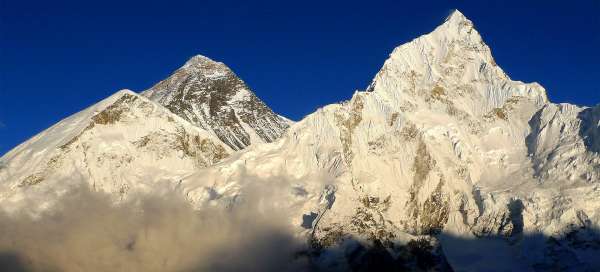
The most photogenic places: Probably the most classic amazing photos are from Lake Phewa in Pokhara, where the Annapuren ridge is reflected on the surface. Furthermore, the view from Kalla Patthar on Everest and the surrounding mountains. Number three is Nagarkot (taken with a long zoom to „pull“ the distant ridge of the Himalayas to the top of this hill.
People photoshoot
In Nepal, thanks to its diverse ethnic composition, it is very interesting to take pictures of people, especially if they have local costumes or if you take part in some festivities.
The willingness of local people to have
The locals do not usually problems with the fact that you are taking pictures of them.
Photogenic group of people
- Interesting are the carriers with huge costs. – Young children or the elderly are very photogenic when working in the fields or with scaffolds.
Photos of nature
In Nepal you will definitely take pictures of mountain scenery. When composing, do not forget one thing – quite often the monumentality of the mountains does not stand out in the photo – the loss of scale. It is ideal to add some scale to the composition / a tree, a little man on a rock cliff, etc./
The best sunrises / sunsets
When photographing mountains do not be on steady habits, often mentioned in guidebooks. Rather first see how a mountain is angled against the sun. For example, traditionally tourist go on the sunrise Kala Pattar and Gokyo Ri. The sunset from these prospects is far better – of course, if it comes to the weather.
Best places for a big zoom
Great zoom worth in Chitwan, not only for taking pictures of wildlife, but also to „pull“ distant silhouette of the Himalayas at sunset. Zoom fits indeed in all places where you have the mountains on the horizon.
Where is the best places for photographs
Generally, it is good to shoot the sky in places where the air is dry and there is no light smog, it is in Nepal in all areas „behind Himalayas.“ Here you can enjoy the beautiful scenery of the Milky Way.
How to speak here
Arranging in Nepal is usually not a problem. All you need is the basics of English. Sometimes they can cause you problems, especially in the countryside, inscriptions only in the local Devanger script.
Official languages
The official language of Nepal is Nepali
Another local languages
Because of the varied national composition of this country is spoken hee of more than 36 other languages (such as Maithili, Bhojpuri, Thara Tamang)
Which foreign languages are spoken here
A lot of people here understand at least a little English. If you use the services of larger tourist agency is not problem getting a guide speaking eg. German, Spanish, French, etc.
What type of alphabet is used here
In Nepal, he writes Devangari letters. Many important and interesting inscriptions, fortunately written in the Latin alphabet.
Tourist dictionary
Nadi = river, Khola = stream, Kharka = mountain meadow, Phedi = foot of the mountain, Tsho = Lake, La = Pass
Population
Nepal has a population of over twenty-six million and is relatively densely populated. Of course, most people live in Kathmandu and then in the lowlands near the border with India. However, the mountains are also relatively inhabited thanks to scattered villages with rice terraces. Only in the most remote valleys there is no permanent population.


