The most beautiful sights in Budyšín
The best of Budyšín

Budyšín is a beautiful city in the southeastern part of Saxony, located in the historical territory of Upper Lusatia. You will find dozens of beautiful places here and it will take you quite some time to explore all the picturesque corners and alleys. Let's take a look at the most beautiful monuments of Budyšín.
Ortenburg Castle in Budyšín
A castle with a famous tower
On the highest point of Budyšín, on a rocky plateau above the Spree River, you will find Ortenburg Castle. It is typical for its Gothic Matthias tower with a red painted top. You can see the castle itself in its entirety only from the viewpoints to the north of it. The area itself is somewhat aesthetically spoiled by the built theater stage. continue reading


Town hall in Budyšín
Dominant of both main squares in Budyšín
Between the two main squares in Budyšín – Fleischmarkt and Hauptmarkt, there is a monumental town hall. It is typical for its huge clocks. The town hall tower itself is 54 meters high. continue reading

The old waterworks in Budyšín
Alte Wasserkunst
One of the most famous monuments of Budyšín is the Alte Wasserkunst. At first glance it looks like a defensive castle tower, but surprisingly it is a waterworks building. The water here was pumped up and then by gravity distributed through pipes throughout the city, located high above the Spree River. continue reading

Cathedral of St. Peter in Budyšín
The tallest building in Budyšín
Budyšín is famous for its many towers that complete its picturesque panorama. The tallest of them is the tower of the Cathedral of St. Petra almost 84 meters high. The church is considered one of the most important in all of Saxony. You can find it right across from the beautiful town hall on the Fleischmarkt square. The interesting thing here is that the church is simultaneous, i.e. services of two churches are held here: Roman Catholic and Evangelical continue reading

Reichenturm
The eastern landmark of the city
At the eastern end of the historic center of Budyšín, you will find the beautiful 56-meter-high Reichenturm tower. It is an unmissable landmark of the Kommarkt square, where farmers' markets are frequent. The tower is accessible and from its top there is an interesting view of the city continue reading

The old barracks with the Serbian tower
A nearly destroyed monument
During the construction and expansion of the barracks in Budyšín at the beginning of the 19th century, the historic Serbian Tower was also to be demolished. Fortunately, it was preserved – one of the first examples of historic preservation in Germany. Now together with the barracks, they form an interesting spectacle. continue reading

St. Michael's Church in Budyšín
Iconic church above the river Spree
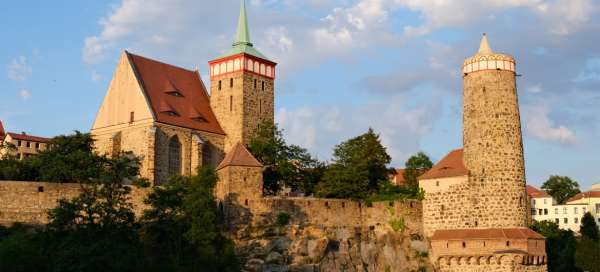
One of Budyšín's iconic buildings is St. Michael's Church. It completes the well-known cityscape with a number of towers. The church was dedicated to St. Michael, who allegedly appeared here during the Hussite siege of the city and saved them from the besiegers. continue reading

Ruins of the church of St. Nikolai
The most mysterious monument in Budyšín
Cemetery with the ruins of the church of St. Nikolaje certainly has the most mysterious atmosphere of all the monuments in the city. In addition, there are very interesting views from here. Even so, very few tourists visit here. continue reading

Ruins of the Monk's Church in Budyšín
Water tank in the ruins of the monastery
One of the dominant features of the city is the large reservoir located in the ruins of the former Monk's Church. The ruins are somewhat reminiscent of the remains of monasteries in Ireland. It burned down at the end of the 16th century and was never restored. continue reading